
AMarkets
AMarkets Review 2026: Analysis of an Offshore Giant — Is It Worth the Risk?
AMarkets Review/ In the world of online trading, there is a classification of brokers. At the top are giants regulated by the FCA (UK) or ASIC (Australia), where client funds are protected by strict laws and compensation funds. At the bottom of the pyramid are thousands of small “kitchens” that disappear as quickly as they appear. Somewhere in the middle are companies like Amarkets, attracting traders with flashy conditions but making financial security experts shudder.
An Amarkets review is not just a description of another trading website. It is an investigation into the phenomenon of a broker that has been operating since 2007, serving over 350,000 clients, yet deliberately avoids obtaining licenses in developed financial jurisdictions. In this article, we will dissect Amarkets down to the smallest details: from what its “regulation” in the Comoros Islands actually means, to the hidden terms of bonuses and real reviews from disappointed clients.
If you are considering this broker for investments, read this material to the end. It might just save your deposit.
AMarkets Review. Legal Status and “Regulation” — The Truth They Hide
Geography of Registration: Comoros, Cook Islands, St. Vincent
The first thing a user sees on the Amarkets website or in reviews are the logos of regulators: FSA, FSC, MISA. To an unsophisticated trader, this looks impressive. However, behind these abbreviations lie jurisdictions that professionals call “offshore dumping grounds” due to their approach to regulation.
According to official data and public information, Amarkets operates through three main legal entities:
- AMARKETS LTD (Registration number: T2023284) — registered in the Comoros Islands (Mwali). Regulator: Mwali International Services Authority (MISA).
- AMARKETS LLC (Registration number: LLC14486/2023) — registered in the Cook Islands. Regulator: Financial Supervisory Commission (FSC).
- AMARKETS LTD (Registration number: 22567 BC 2015) — registered in St. Vincent and the Grenadines (SVG). Regulator: Financial Services Authority (FSA).
At first glance, an impressive portfolio. But let’s break down what each of these “regulators” actually represents.
AMarkets Review. What is “Registration” and How is it Different from a “License”?
The key difference that Amarkets and similar brokers deliberately blur in their marketing is the difference between company registration and prudential supervision (licensing).
• Registration in St. Vincent (SVG FSA): This is the most telling example. The SVG FSA does not issue licenses for Forex or CFD business. This authority publicly states that it does not regulate, supervise, or oversee international business companies engaged in such activities. Essentially, registration in SVG is just an entry in a registry, allowing the company to open a bank account but imposing absolutely no obligations on the broker regarding client protection, capital adequacy, or business conduct.
• Registration in Comoros (MISA) and the Cook Islands (FSC): These bodies fall into the category of “offshore regulators.” Yes, they issue licenses, but capital requirements are minuscule (often $10,000 – $50,000 is enough), checks are formal, and there is no real oversight of activities. They are “referees” who don’t watch the game and cannot penalize offenders.
Comparison with “Tier-1 Regulation”: Imagine the difference between an international airline pilot who undergoes dozens of health and skill checks annually (FCA, CySEC, ASIC) and a driver who simply registered their car but never passed a driving test (offshore “license”). Amarkets is the “driver” who registered the car but can drive in any lane, ignoring the rules.
Absence of Licenses in Developed Countries
For any serious broker, the “mark of quality” is holding licenses in major financial centers like the UK (FCA), Cyprus (CySEC), or Australia (ASIC). These regulators require:
• Segregation of funds: Client money is held separately from the company’s operational accounts. If the broker goes bankrupt, traders’ funds don’t go towards paying the company’s debts.
• Negative balance protection.
• Regular reporting and auditing.
• Compensation funds (e.g., up to £85,000 in the UK).
Amarkets holds none of these licenses. Moreover, it has been publicly warned by regulators in Malaysia (Securities Commission Malaysia), Italy (CONSOB), and Ukraine (NSSMC) for conducting activities without the necessary permissions in those countries. This means the broker knowingly operates in a “grey area,” attracting clients from countries where it is not authorized to do so.
AMarkets Review. “Safety Umbrellas”: The Financial Commission and Verify My Trade
In response to criticism about the lack of real regulation, Amarkets points to its membership in The Financial Commission and audits by Verify My Trade (VMT).
• The Financial Commission: This is not a government regulator, but a private organization — a “mediator.” Yes, it provides a compensation fund of up to €20,000 per complaint. This sounds reassuring, but it’s a drop in the ocean compared to government guarantees. Furthermore, it’s a “voluntary” structure, and its decisions are not legally binding. It’s like going to an arbitrator in a dispute with a store instead of filing a lawsuit — the decision might be fair, but enforcing it is much harder.
• Verify My Trade (VMT): A monthly audit of order execution quality. However, VMT only checks execution, not the company’s financial stability, fund safety, or its intentions. A broker can execute trades perfectly while using client funds to pay bonuses to other traders, leading to bankruptcy.
Conclusion: Amarkets’ legal structure is built on the principle of maximizing the minimization of responsibility towards the client. The absence of supervision by “Tier-1 regulators” is not a marketing gimmick (“we save on costs”), but a fundamental risk of losing all invested funds.
Registration and Getting Started — Simplicity Hiding Risks
The account opening process with Amarkets is indeed simple and takes no more than 3 minutes, as noted in many reviews. However, this simplicity also has a downside.
Registration Process: What You Need to Know
To open an account, a new client only needs to enter a name, email, and phone number. Note: at the registration stage, you are not asked about your country of residence, financial status, or trading experience. This should raise a red flag.
Regulated brokers are required to conduct an appropriateness test to prevent unsophisticated investors from losing money on complex instruments. Amarkets skips this step, opening the door to trading with leverage of 1:3000 for anyone. Essentially, the broker shifts the responsibility for risk assessment from itself to the client — a morally questionable practice.
Identity Verification (KYC)
Yes, the broker does have a KYC (Know Your Customer) procedure. Eventually, you will be asked to upload your passport. This is a standard requirement to comply with international anti-money laundering laws.
Security Risks: Sending passport scans to a company registered in the Comoros Islands always carries a risk of data leakage. Offshore companies often have significantly lower levels of cybersecurity and responsibility for protecting personal data compared to European or American entities.
Minimum Deposit: The Entry Ticket
The minimum deposit is $100 for a standard account and $200 for ECN/ZERO. On one hand, it’s accessible for beginners. On the other hand, it’s the “perfect” amount for an offshore broker. One hundred dollars is not a large enough sum to sue over if lost, but it’s not so small that a trader won’t try to recoup it using leverage and bonuses. It’s a psychological anchor that draws the trader in deeper.
AMarkets Review. Trading Conditions and Platform — Strengths on Display
Despite the critical assessment of security, it would be unfair not to note the strong technological aspects of Amarkets. The broker has invested in what traders see.
Platforms: Industry Standard MT4/MT5
Amarkets offers a choice between the classic MetaTrader 4 and MetaTrader 5 terminals. This is the “standard” for millions of traders. Versions are available for PC (Windows, Mac), web, and mobile devices (iOS, Android). A definite plus is that the broker doesn’t reinvent the wheel and provides stable, familiar software.
MT4/MT5 from Amarkets support:
• Trading with Expert Advisors (EAs) for automated strategies.
• An advanced set of charting tools and indicators.
• Market Execution, which theoretically reduces the likelihood of requotes.
Account Types and Commissions
Amarkets offers three main account types for clients:
• Standard account — the most expensive due to wide spreads. In volatile markets, spreads can widen to 2-3 pips, making intraday trading costly.
• Zero and ECN accounts — A commission of $2.5 per lot on the ECN account is a standard rate. However, note that the commission is charged “per side,” meaning opening and closing a position results in a total commission of $5 per lot.
Leverage: The Devil’s Temptation
The maximum leverage is 1:3000. This is a toy for gamblers. With such leverage, even a minor market movement of 3-4 pips can wipe out a deposit if a stop-loss isn’t used. Top regulators (e.g., ESMA in Europe) limit leverage for retail clients to 1:30 precisely to protect them from instant ruin. By offering 1:3000 leverage, Amarkets is betting that 90% of beginners will blow up their deposit within the first week, but will have generated enough commissions for the broker in the process.
AMarkets Review. Analytics and Education — Marketing or Utility?
The “Education” and “Analytics” sections on the Amarkets website look comprehensive. Daily reviews, an economic calendar, a trader’s calculator, Autochartist.
4.1. Quality of Analytical Materials
Most of the analytical reviews offered by the broker are superficial. They are general market news that can be found for free on any major portal like Investing.com. There is no deep, proprietary analytics that would provide a real advantage.
Signals and Auto-trading
The broker promotes copy-trading services and offers access to 20 trading robots (EAs). A hidden danger lurks here. Often, the robots advertised by the broker (even indirectly, through “partners”) are optimized for historical data but fail in live accounts. Alternatively, they are configured for aggressive trading with huge leverage to quickly “kill” the account. The goal of such robots is not to make money for the client, but to generate as many lots as possible for the broker.
AMarkets Review. Promotions and Bonuses — Casino Game Rules
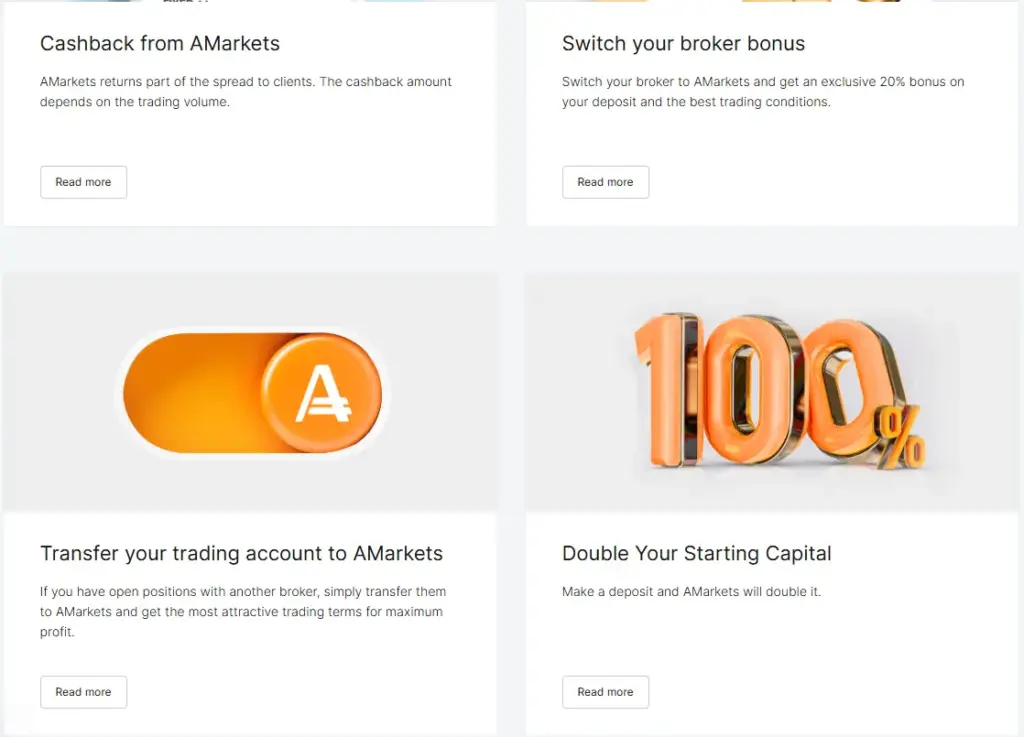
Amarkets’ bonus system is a classic example of how offshore brokers tie clients to them and create an illusion of “free money.”
Types of Bonuses
The most common are welcome deposit bonuses (e.g., 30% or 50% of the deposit amount) and various promotions for Gold status clients.
Wagering Requirements (Trading Turnover)
The most important and carefully hidden part of bonuses is the wagering requirement. Typically, brokers (and Amarkets is no exception) require a huge trading turnover before bonus funds become available for withdrawal or convert to real money.
Suppose you deposit $1000 and receive a $500 bonus (50% bonus). To withdraw this bonus (and often your deposit along with it), you might need to achieve a turnover of, say, 50 times the bonus amount: 500 * 50 = 25,000 lots (or, translated into currency volume, this could be millions of dollars).
The Math for the Client:
To wager such a bonus, a trader is forced to trade insane volumes, risking their own deposit. Even if the strategy is profitable, the huge turnover generates commissions that “eat up” the profit. The broker earns from commissions, while the trader destroys their account trying to free the “free” money. Bonuses in offshore firms are always a trap. They are a mechanism for retaining clients and encouraging reckless trading.
Cashback and Loss Compensation
There are programs like trading cost compensation for GOLD status clients. Essentially, it’s a partial rebate of the spread or commission. This is a plus, but it’s minuscule compared to the potential losses from trading with an unstable deposit and a bonus.
AMarkets Review. Partner Program (Introducing Brokers)
Amarkets actively develops its partner (IB) network. This is one of the main channels for attracting clients. The website is filled with offers for webmasters and Forex clubs.
Conditions for Partners
Partners are offered:
• High revenue share (RevShare) from the spread/commission paid by referred clients.
• CPA (Cost Per Action) — a payment for each referred client who makes a deposit.
• A multi-level structure.
The Ethical Problem of Partnership
The main problem with affiliate programs for brokers like Amarkets is that it is in the partner’s interest for the trader to:
- Deposit as much as possible.
- Trade as actively as possible (generating turnover).
- Not withdraw money from the account.
The partner gets paid when the trader makes transactions and loses the account. It’s not in their interest for the trader to profit and leave; it’s beneficial for the trader to make many transactions. This creates a conflict of interest. Many “gurus” promoting Amarkets are precisely such partners, not independent advisors.
AMarkets Review. Deposits and Withdrawals — The Fine Print
Withdrawal Fees and Speed
The main pain point for any trader. Although the broker boasts about fast withdrawals, client reviews often contradict this.
Officially: Withdrawal takes from a few minutes to 24 hours (depending on the payment system).
In practice: Delays often occur during the verification stage or when requesting large withdrawals. Additionally, a withdrawal fee is charged, the amount depending on the payment system.
Note: You deposit without a fee but withdraw with a fee. This is a common practice to offset the broker’s transaction processing costs, but it reduces the trader’s final profit.
Chargeback Policy
Unlike regulated brokers that are subject to financial ombudsmen, disputing a transaction with Amarkets via a bank (chargeback) is more difficult. The bank may refuse because you voluntarily transferred money to a company registered in an offshore zone and agreed to its user agreement, which states that you acknowledge all risks.
AMarkets Review. Client Reviews Online — Two Sides of the Coin
Analyzing reviews is the most controversial but important stage. Amarkets has high ratings (e.g., 4.8 out of 5 on Trustpilot, where it moderates its own reviews), while receiving extremely negative comments on specialized forums and warning sites.
Critical Reviews: Red Flags
A deeper analysis by experts reveals systemic problems:
- Withdrawal issues upon first significant profit: The classic scenario. A trader trades, makes a small profit, and withdraws it without problems. As soon as the account grows 5-10 times, “technical checks” begin, additional documents are requested, followed by accusations of a “prohibited strategy” (even if not specified in the rules) or account blocking. The “trapdoor” mechanism activates precisely when the broker needs to actually pay out.
- Regulatory Warnings: As mentioned, black marks from CONSOB and the SC Malaysia are not just “technical details.” They represent an official government position: “This company is operating illegally; do not trust them with your money.”
- Fraud Allegations: On forums, you can find threads where traders describe how, after requesting a large withdrawal, their account was blocked, and bonuses (which they were trying to wager) were canceled under a fabricated pretext.
8.3. Analysis of “Polished” Reviews
It’s worth understanding that many positive reviews on independent (and not-so-independent) platforms are paid for. The broker’s partners (IBs) often ask their “students” to leave good reviews to maintain an image. The real picture is only visible in “live” forum threads where specific cases of money loss and recovery attempts are discussed.
AMarkets Review. Real Disadvantages of Working with Amarkets — Final Verdict
Summing up this comprehensive Amarkets review, let’s highlight the undeniable disadvantages that outweigh the dubious advantages.
Legal Vulnerability
This is the main and fatal drawback. If tomorrow Amarkets decides to close down (which is very easy to do in an offshore zone), you won’t be able to recover anything through the courts. No FSC of the Comoros Islands will help. The compensation fund of The Financial Commission won’t help you much either, as it is funded by the brokers themselves and has direct ties to them.
Unpredictable Payout Policy
The broker may pay out for months and then “screw over” a client for a large sum. This is not speculation, but the statistical reality of thousands of offshore firms. They operate on a “pyramid” principle: payouts to small players are made from the deposits of new ones, and when a large payout is due, the client is refused, accused of violating the rules. The reason is simple: the broker doesn’t want to lose its own money, and there is no real regulator to force payment.
High Leverage as a Weapon of Mass Deposit Destruction
Leverage of 1:3000 is not an advantage; it’s a way to quickly separate a trader from their money. Psychologically, with such leverage, a trader stops calculating risks adequately. A 1-cent lot turns into a $1 lot, and one market move destroys the account. The broker earns commissions from these suicidal trades.
Conflict of Interest in Bonuses and Affiliate Programs
Bonuses are designed not for you to profit, but to prevent you from withdrawing money while trying to wager them. Partners are interested in you trading as much and as long as possible, even if your trading is unprofitable. The entire Amarkets ecosystem is built around maximizing turnover, not client profit.
AMarkets Review. Conclusion: Who is Amarkets Suitable For?
After such a detailed analysis, a disappointing conclusion is inevitable. Amarkets is a typical representative of the “grey zone” of the Forex industry. It is smart enough to invest in technology and marketing. It is not a scam in the classic “fly-by-night” sense, as it has been operating since 2007. However, its business model is built on attracting clients to a jurisdiction with zero rights protection.
This broker is categorically NOT suitable for:
• Investors who value their capital.
• Traders planning to withdraw large sums of profit (more than a few thousand dollars).
• Those seeking reliable regulation and protection.
AMarkets Review. Amarkets MIGHT be suitable (with a huge dose of skepticism) for:
• Extremely experienced traders who view their deposit as “disposable money” for entertainment and are ready to lose it at any moment with no hope of recovery.
• Scalpers who prioritize speed and withdraw profits daily, without accumulating large sums on the account (although the risk of blocking still remains).
Alternative: If you care about your money, look for brokers regulated by the FCA (UK), ASIC (Australia), or at least CySEC (Cyprus). Their conditions are stricter, leverage is lower, but your money is genuinely protected by law. In the world of finance, as in aviation, safety is always more important than speed and a cheap ticket.
Check the ratings and reviews of brokers on thepage. Also read the articles in the News section.
More information about forex brokers’ affiliate programs is available on the website.
Please sign in to your account to leave a review